New collaborative program aims to improve emergency care

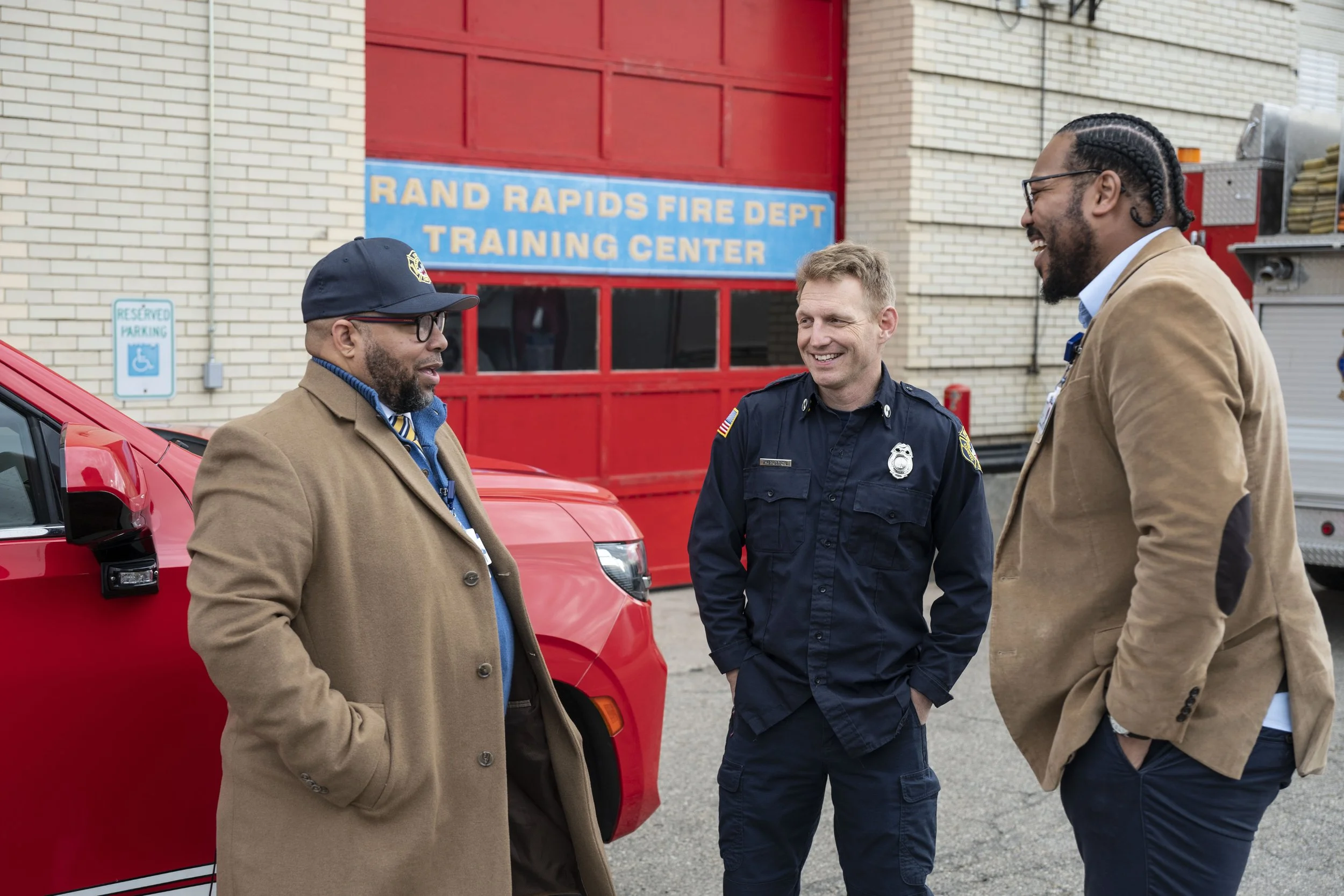
Photo courtesy of Corewell Health
The Grand Rapids Fire Department and Corewell Health™ have partnered to pilot Medical Priority and Wellbeing Response (MPWR), a new program designed to improve care coordination and help Grand Rapids residents access the services they need. The initiative integrates a full-time community health worker into Grand Rapids Fire Department response teams to reduce preventable emergency department visits and redirect 911 calls to the appropriate level of care by connecting community members to nonemergency medical services or other essential resources.
The pilot will run for six months, with the hope of demonstrating success so it can continue long-term. By addressing social needs alongside emergency response, this initiative represents a new model for community health and safety and is the first of its kind in West Michigan.
“Every day, our firefighters see firsthand how often our residents call 911 not just because of a medical emergency, but because they don’t know where else to turn,” said Fire Chief Brad Brown. “This partnership with Corewell Health is about changing that. It’s about showing up with the right kind of help, whether that’s a fire truck or a helping hand to navigate life’s challenges. I’m proud of our team for embracing this new approach, and I wholeheartedly support this effort to build a stronger, more connected Grand Rapids.”
The Grand Rapids Fire Department responds to more than 17,000 medically related calls each year, and many calls are rooted in social challenges rather than medical emergencies. The fire department’s leadership team began looking for a new approach, one that could help connect people to support without overwhelming their emergency response teams or local emergency departments.
“This program is about meeting people where they are and making sure help is within reach when life feels overwhelming,” said William Burress, Community Health Worker, Corewell Health. “Every connection we make has the potential to change a life. Working alongside first responders and community partners means we can reach people sooner, remove barriers and create pathways that lead to lasting change for a stronger, healthier Grand Rapids.”
This pilot program brings together a trained community health worker and first responders as a specialized team focused on addressing social and non-medical needs alongside urgent care. By working together, they will help community members access the most appropriate resources, such as food and housing assistance, medical care, mental health services and other community programs, while easing pressure on emergency departments. In this role, the community health worker will not only respond alongside firefighters on select calls but also proactively identify community members who may have contacted 911 for nonemergency needs.
“Models like this are effective because health outcomes are shaped by more than medical care, as they are influenced by housing, food security and social support,” said Kaley Petersen, Senior Director, Healthier Communities West, Corewell Health. “By partnering with the Grand Rapids Fire Department, we are creating a new way to deliver care that meets people’s needs in the right place, at the right time. It’s about creating a model that is driven by strong partnerships like this, where shared vision turns into real solutions for people.”
West Michigan Newspop Digital Partners

Community
- Ada
- Algoma
- Allegan
- Allegan County
- Allendale
- Alto
- Baldwin
- Baltimore Township
- Barry County
- Battle Creek
- Belding
- Belmont
- Benton Harbor
- Berrien Springs
- Bridgman
- Bryon Center
- Byron Center
- Caledonia
- Cannonsburg
- Carlton Township
- Carson City
- Cascade
- Cedar Springs
- Cloversville
- Comstock Park
- Coopersville
- Creston
- Crockery Township
- Douglas
- East Grand Rapids
- Eastmanville
- Eastown
- Eaton Rapids
- Fennville
- Ferrysburg
- Forest Hills
- Fruitport
- Georgetown Township
- Grand Haven
- Grand Rapids
- Grandville
- Greenville
- Hamilton
- Hart
- Hastings
- Hastings Township
- Holland
- Hope Township
- Hopkins
- Hudsonville