University giving students opportunity to build and launch a real satellite

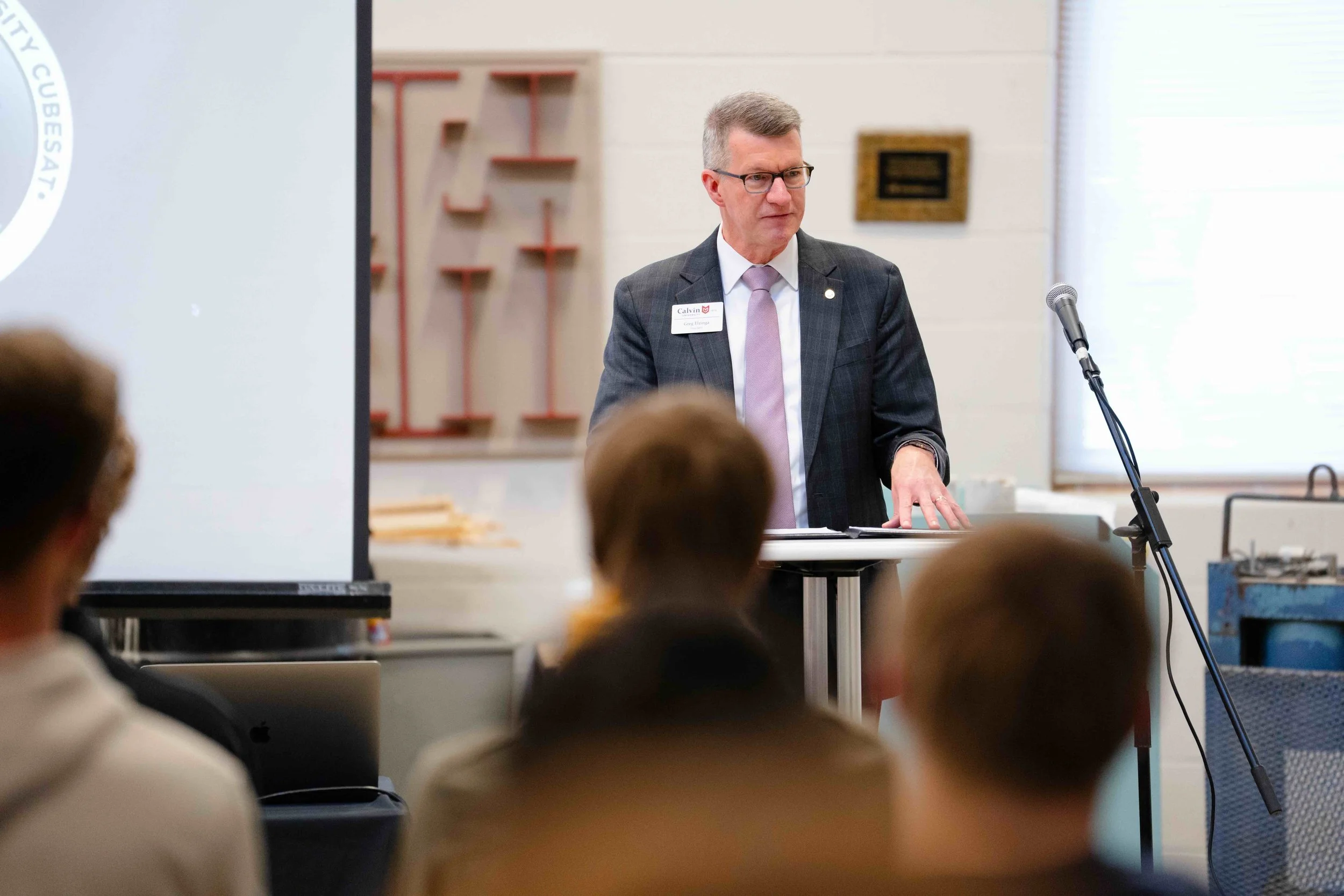
Photo courtesy of Calvin University
Calvin University is launching a new CubeSat program within its aerospace engineering curriculum, giving students the rare opportunity to design, build, test, and operate a real satellite that could be launched into orbit. The program is made possible by a generous gift from Calvin alumnus Michael and Wendi VanWoerkom, founder of ExoTerra, an aerospace company specializing in satellite propulsion systems and recently acquired by Voyager Space.
A CubeSat is a standardized, miniature satellite - typically measuring just 10 centimeters per side - that universities and research institutions use to conduct space-based experiments. Over the next two years, Calvin students will work in interdisciplinary teams to develop a satellite mission, design the hardware and software, and submit the project for space qualification. If approved, NASA may launch the CubeSat into orbit aboard a future rocket mission.
“This is about as real as aerospace engineering gets,” said Ken Visser, Professor of Aerospace Engineering at Calvin University’s aerospace program. “Students won’t just study satellites - they’ll actually build one, test it, and operate it from here on campus.”
The CubeSat project will involve students from across disciplines, including aerospace engineering, physics, computer science, and related fields. Students will be responsible for every aspect of the mission: selecting a scientific experiment, designing satellite systems, programming onboard software, managing communications, and analyzing real-time telemetry data once the satellite is in orbit.
Calvin is also creating new facilities to support the program, including: A clean room for satellite assembly, thermal vacuum chamber to simulate space conditions, vibration table to replicate launch stresses, and a dedicated “mission control center” for real-time satellite operations
A large public display in the engineering building will allow the campus community to track the satellite as it orbits Earth.
“Calvin gave me the foundation for everything I’ve done,” VanWoerkom said. “This program gives students a chance to do something extraordinary - something that puts them right at the frontier of the space industry.”
The CubeSat initiative also aligns with broader developments in space exploration, including NASA’s Artemis program, which aims to return humans to the Moon and establish long-term lunar operations. Future student missions could explore applications ranging from Earth imaging and environmental monitoring to space communications and scientific research.
“This is the kind of experience students usually only get at very large research universities,” said Visser. “Our goal is simple. We want students to come to Calvin and graduate having built something that literally went into space.”
West Michigan Newspop Digital Partners

Community
- Ada
- Algoma
- Allegan
- Allegan County
- Allendale
- Alto
- Baldwin
- Baltimore Township
- Barry County
- Battle Creek
- Belding
- Belmont
- Benton Harbor
- Berrien Springs
- Bridgman
- Bryon Center
- Byron Center
- Caledonia
- Cannonsburg
- Carlton Township
- Carson City
- Cascade
- Cedar Springs
- Cloversville
- Comstock Park
- Coopersville
- Creston
- Crockery Township
- Douglas
- East Grand Rapids
- East Hills
- Eastmanville
- Eastown
- Eaton Rapids
- Fennville
- Ferrysburg
- Forest Hills
- Fruitport
- Georgetown Township
- Grand Haven
- Grand Rapids
- Grandville
- Greenville
- Hamilton
- Hart
- Hastings
- Hastings Township
- Holland
- Hope Township
- Hopkins